Category: Gadgets & Toys

Well, I finally folded...

I've wanted an e-bike for ages, ever since I first tried one many, many years ago, but most of my normal cycling destinations are close enough that I didn't really feel I had an excuse to buy one.

But then we started to think that folding bikes would also be useful when campervanning, and so the idea started to grow of getting folding e-bikes... and we are now the proud owners of two Eovolt "Afternoon"s.

Interestingly, we just rode these and found we liked them slightly more than the others we tried, but when we got them home and started looking for reviews, accessories, etc found they seemed to have comparatively little presence online (at least, in the English-speaking world). I certainly hadn't come across them on YouTube, for example, when researching possible brands. So here's my modest attempt at rectifying that!

A greener buzz?

When I was young, electric toothbrushes were something we laughed at. Imagine being too lazy even to wiggle a toothbrush up and down without powered assistance! But as an adult, I discovered that most dentists now thought they were rather good, and recommended them.

Electric toothbrushes did a better job of cleaning in general, they said, and the smaller head would get into places that manual toothbrushes wouldn't reach. Perhaps, I thought, gadget enthusiasts like me shouldn't feel embarrassed about actually trying one. I wouldn't have to admit it to anyone..

"There's a huge range", I remember my dentist telling me. "Don't go for the ones with silly prices and dozens of bells and whistles. 40 quid or so is probably about right."

So, for a while, that's the kind of thing I used. They're probably about 50 or 60 quid now. They have a rechargeable battery, sit on a base that charges it inductively, and have a simple timer to help you spend the right amount of time brushing. You know the kind of thing.

But one thing about them always bugged me: the batteries were rubbish.

Long before the motor or the casing gave up the ghost, the built-in, non-replaceable battery would die, or stop holding enough charge even for one brush, and the whole thing would have to go in the bin. Then I'd buy a new one, which came with its own charging base, so the previous base, and cable, and plug - they all went in the bin too.

This was not very good for my wallet, and a great deal worse for the environment.

So I expect you will laugh, gentle reader, when I tell you that what changed my purchasing habits was brushing my dog's teeth. Yes, our spaniel gets her teeth brushed every night, and she enjoys her chicken-flavoured toothpaste, but won't tolerate brushing for very long, so we got her an electric brush, too, to make maximum use of the time available!

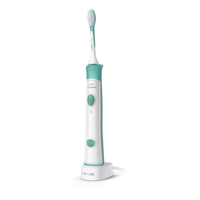
We weren't going to buy her any big 60-quid devices, though, so we looked online for ones designed for children, and Tilly now has a children's Oral-B toothbrush. It's pink and blue and I think it has fairies or princesses or unicorns on it, but she doesn't seem to mind.

And as we used this, a few things struck me:

  • The motor mechanism looked as if it was just the same as my own expensive one.
  • It took the same brush heads.
  • It used replaceable AA batteries. I had plenty of rechargeable Eneloop AAs. (Take a look at my post from about 10 years ago to see why I like those. I'm still using much the same system now, and most of the batteries I had back then are still in use.)
  • This also meant I didn't need to have charging bases and cables in the bathroom.
  • It didn't have a timer. But I could count elephants.
  • It cost about one quarter of the price.

And so I now have, and can recommend, a very basic Oral-B battery-powered toothbrush. Currently £14.99 on Amazon. It has lasted longer than my previous expensive ones, and the two AA batteries hold their charge way longer than the built-in ones ever did. Occasionally, I take them out to charge and swap in some fully-charged ones from my drawer -- that's why I love Eneloops and similar rechargables: they stay fully-charged in the drawer -- and freshly-charged batteries seem to last for weeks.

Since I got this, some years back, nothing has gone in the bin except the occasional elderly brush head, and when it does eventually die, it'll be far less wasteful than something that takes its batteries and charging base to the grave with it.

Oh, and best of all? Mine doesn't have any princesses or unicorns on it. Tilly is still bitter about that.

Dumb switches and smart lights?

Almost all of our lights are now 'smart': controllable by software, timers, motion sensors etc as well as switches.

If you've done this, though, you'll know there's a problem: how do you stop people turning things off at the wall, at which point your smart lights become remarkably dumb?

Here's how I do it:

(Direct link)

With great power...

Back in the early days of USB, my friend Andy Fisher and I were bemoaning some of its design flaws as a communication system.  "But", he pointed out, "USB is the first universal power standard".   I laughed, and agreed. People didn't really think of USB as a power source very much then, so this was an interesting observation.  

Andy and I were doing a lot of flying to places with different mains power standards, and we had phones from people like Nokia and Motorola, so we had to carry lots of chargers with a wide range of connectors and adaptors everywhere we went.  The idea of a predictable socket giving you predictable power was very appealing, even if it was only 5V at 1A. (Though I later realised there was perhaps one earlier holder of the 'universal power standard' title: the car cigarette-lighter socket.)

Screenshot 2023 09 21 at 09 38 18This week the news is full of the fact that Apple are switching the iPhone to use USB-C.  This is assumed to be largely the result of EU directives compelling them to do so, but my latest iPad and laptop from them are already USB-C, so it was probably inevitable anyway.  Personally, the 'Lightning' cable has always worked very well for me; I've never had one fail and on the rare occasions when I plug it in my phone and it doesn't charge, the solution is invariably to remove the pocket-fluff in the socket (which, by the way, is best done with a wooden cocktail stick).  So for many people, whether you approve of the change probably depends on whether you have bought lots of Lightning-based accessories in the past, and how that balances for you against not having to do so in the future!

USB-C, on the higher-end phones, will give much faster transfer rates, which is important for those copying substantial video clips to their laptops, but probably irrelevant for most other people.  And USB cables can be highly confusing, because you can run other protocols over them alongside the USB communications; DisplayPort being a key example, but also including things like Thunderbolt and PCI Express.  When you plug a cable between two USB-C sockets, therefore, it can be hard to know what you'll actually achieve: the projector in this meeting room has a USB-C socket, but will that allow me to display my presentation or just charge the remote control?  Might it even recharge my laptop for me?  Make sure you try it in advance, because you can't tell from the sockets, and it may also depend on the quality of cable you use to connect them.  Plugging things together will almost certainly be a safe operation, but it may be a disappointing one.

Sometimes, though, you can get a pleasant surprise.  I remember when I wanted to connect a small stick-type computer to my monitor, and plugged in a USB-C cable to provide the DisplayPort video connection, only to find the computer booting up because the monitor was also able to power it, through that same single cable.

And while I still regularly complain about USB in general -- I have two or three hubs on my desk to connect all my peripherals, from reputable manufacturers, yet I regularly get messages about some external drive being improperly disconnected, or find some camera needs unplugging and replugging before it appears in Zoom --  I do have to admit that USB-C, at least from the 'universal power standard' viewpoint, does seem to work rather well, so I'm in favour of this change for technical reasons, as well as environmental ones.

If you want to know more about USB-C power, what it can do and how it does it, I recommend this Hackaday article by Arya Voronova.  He points out that there are still some issues -- if you plug your battery power pack into your laptop, for example, do you expect the laptop to charge the battery, or the other way around? -- but overall, it does seem like progress.

The shelf behind me in my study has three large boxes labelled 'Power Supplies < 12V', 'Power Supplies 12V' and 'Power Supplies >12v', because I always hated throwing them away.  In the past, power supplies generally died more regularly than the things they were powering, and it was very satisfying to be able to reach into one of these boxes and give a computer, drive enclosure or ethernet switch a new lease of life.

But I think it may be time for a clear-out.

PSU boxes

I now have a reasonable number of adaptors to connect USB-A to USB-C sockets and vice versa, and this should work in most simple cases. But you'll get the lowest common denominator of the two standards, which may not be enough. Just last week, I was installing a new phone mount in my campervan; one that would hold my phone in place magnetically and charge it wirelessly. The Magsafe wireless charger came with a USB-C cable and I just plugged it, via an adaptor into to the USB socket on my dashboard. But... Nada. It turns out that the wireless charger needs more power than a standard USB-A socket can provide. I did actually need to plug it into USB-C.

Fortunately, that was easy to solve. Because my dashboard is also fitted with the original universal power standard. A cigarette lighter socket.

Car usb c adapter for 12v lighter socket

Watching the clock

I've written several times about my enthusiasm for the Apple Watch, but even eight years after getting my first one, I'm still discovering uses for it.

We've spent the last few nights in our campervan on a delightful small campsite in Devon.

Picture of campervan in a bucolic setting

There are loo and shower facilities in a nearby building but, unusually these days, you do need to insert a pound coin if you want to use the shower. It's a fine shower, and I didn't mind paying, but since the meter is outside in the corridor, you don't get any warning before the water shuts off suddenly after six minutes, possibly leaving you rather soapy...

So even in this low-tech environment, where we treat an electricity supply as something of a luxury, there's great benefit to be derived from a waterproof watch which can be instructed, with a couple of clicks or a spoken command, to warn you shortly before your shower is going to finish!

Zappi Days

When I installed my home solar system, I also replaced my perfectly-functional car charger with a new one: a Myenergi Zappi. Why?

The Zappi is a popular charger, designed in the UK, and rapidly finding favour in other parts of the world. Here, I talk about what it can do, things you might need to take into account if connecting to a car like the Tesla, and a little bit of magic geekery I set up to make it fit my needs even better.

(Direct Link)

You are my sunshine...

We've just had a solar/battery system installed, and because I've spent a lot of time planning and thinking about this over the last year and a half, and because it has some slightly unusual aspects, I decided to create a video about it.

This starts off as a pretty basic introduction of solar power, and ends up going into some detail about why mine is arranged the way it is. This means that it's longish... but I hope it might be of interest to anyone considering installing, or expanding, a similar system.

(Direct link)

Mostly Armless

Here's a completely unsolicited recommendation for a product I just happen to like quite a bit and have been using for many years.

Having been fortunate enough to have excellent eyesight for the first four and a half decades of my life, I found that, as for so many people, things started to go downhill from there. One of the first things I discovered was that reading in bed was decidedly tricky, especially if, like me, you like lying on your side, and the arms of your reading glasses are mashed into the pillow.

"Aha!", I thought, "There's a solution for this. I need some pince-nez!" And I tried experimenting with antique ones purchased from eBay, or cheap ones found elsewhere online. One of my early YouTube videos, nearly eight years ago, was about using them inside a cheap VR headset! But they were never very satisfactory.

And then I came across a French company named Nooz. They now make a variety of different reading glasses, but it was the Nooz Originals that caught my eye; the pince-nez du jour, available with 5 different strengths from +1 to +3, and with a nice soft silicon bit to grip your nose.

Nooz pince-nez

They come in a pretty indestructible case which fits easily in your pocket or on your key ring, if you don't, like me, just leave them on the bedside table. Because one thing I can guarantee is that you won't look quite as good wearing them in public as the models on the Nooz website. Or at least, I won't!

But optically, for a 20-quid pair of plastic glasses, they work really quite well, and they solved the reading-in-bed problem perfectly for me: I've used them ever since.

Q wearing Nooz

Now, where are my lorgnettes?

Telephonic nostalgia

Beforeandafteriphone

Mobile phones, before and after the iPhone. An image by Josh Heifferich from 2012.

An email today from my American friend Henry Happel included several photos from their visits to us over the years. Lots of happy memories!

One thing that jumped out at me in a couple of the pictures, though, was that my smartphones were clearly visible. Not, as might be the case nowadays, because everyone was perpetually gazing at the things, but because I carried them on my belt, or some other convenient external location:

Qsf blackberry 7100t

That's a low-slung Blackberry 7100t, which was an exceedingly fine device. It had a pleasing phone-like shape because, unlike many other Blackberries of the time which were full-qwerty-keyboard landscape-orientation devices intended only for email and messaging, this was a phone too and had a keyboard half-way between a traditional phone and a qwerty one:

Blackberry 7100t

As I recall, it worked exceedingly well and was very nicely made. External technology changes outdated it pretty quickly, but I still think of it as one of the better gadgets I've owned.

Note too, of course, that phones didn't include a camera back then, so I also have one of those on display on my belt. It's probably a Canon Digital IXUS.

And it wasn't just geeks like me who valued the usefulness of the phone-holster over any compromises in sartorial elegance. A review of the 7100t at the time talks about how an earlier Blackberry device 'seems to be finding its way onto the belts of business users around the world.' Mind you, perhaps most business users concealed it somewhat beneath their jacket...

Anyway, those were the days when phones actually changed significantly from year to year, and shortly afterwards, I could be seen sporting a Nokia E61.

Qsf nokia e61

(Amongst other things, this was, I think, the first phone I had which was capable of connecting to WiFi.)

Nokia e61

It, too,was generally attached my belt, despite the fact that it was significantly smaller than my current iPhone (except in thickness, where the iPhone wins by a few millimetres). Were our pockets actually smaller back then?

I guess we hadn't yet discovered that the main reason for having pockets in the first place is to carry your phone! We used to need pockets for things like car keys and wallets, but I'm about to head off to the supermarket and my phone will perform both of those functions for me, so my pockets are otherwise pretty much unencumbered.

Still, if you find yourself directing a period drama set between about 2000 and 2007, you might want to add some realism by picking up from eBay a few of these relics of a bygone age... even if they're only part of the costumes.