Tag: maths

Up to no good

When I'm ruler of the world — something which is, by the way, on my list of retirement projects, but keeps getting usurped by urgent tasks like booking an MOT for my mum's car, so I haven't got around to it yet — one of my first actions will be to ban the phrase 'up to' from all marketing materials.

Last year, I complained here about our bathroom cleaner, which announced that it removes 'up to 100% of bathroom grime and limescale', presumably to avoid disappointment for customers who thought it might remove 120% of either. It might actually only remove 80%, but that's fine, because they said 'up to', and it's still clearly a superior product to any competitor which did the same but only claimed to remove up to 90%.

Then a week or two ago, I was sent something that said, if I remember correctly, "Did you know your toilet could be costing you up to £581?" Well, I did, because it might be leaking through the floor, one drip at a time, into the dining room below and the water could seep from there into the secret trunk full of lost Gainsborough paintings that I have hidden below the floorboards. Oh, but, wait... then, it would be costing me much more than £581. So, no, I didn't know it could only be costing me up to £581. Perhaps I was the target market for this advertisement after all.

So I read a little bit further, where I discovered that what they meant (but hadn't said clearly) was £581 per year, but they made no mention of damaged masterpieces, and were really talking to people about the water bill incurred if their WC had a perpetual leak from the cistern into the bowl... people who presumably had previously assumed that this could only be costing them up to £580 per year!

So what I want to know is who came up with the precise £581 figure, and how they could be confident that the cost could never be, say, £600? I couldn't find the notice just now, and, doing a Google search for similar warnings, I discover pages stating that my loo could be costing me up to £200 per year, or up to as much as £1000. But, of course, it could be costing me 5p per annum, and all of their claims would still be valid.

So do watch out for these dubious phrases, but you only need to be on your guard for the next eight months or so, because by the end of this year I shall be ruler of up to 100% of the entire globe.
Misrepresentation

Generally I'm a fan of the Liberal Democrat party here in the UK. Have voted for them on numerous occasions, in fact, though I can't remember whether I did last time. But I do wish they wouldn't resort to such nefarious tactics.

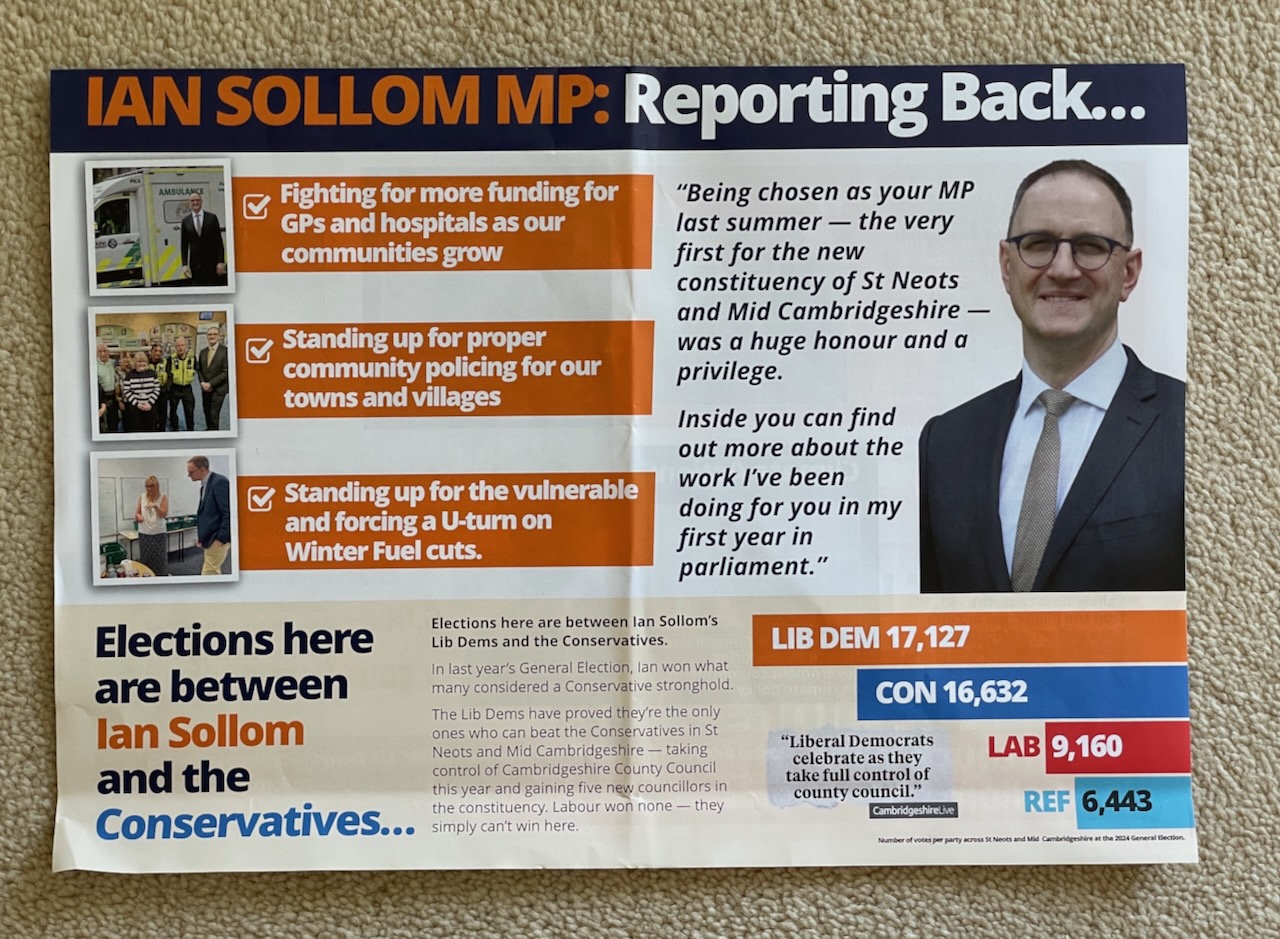
Here's a cheery letter that just came through the door from our MP, Ian Sollom:

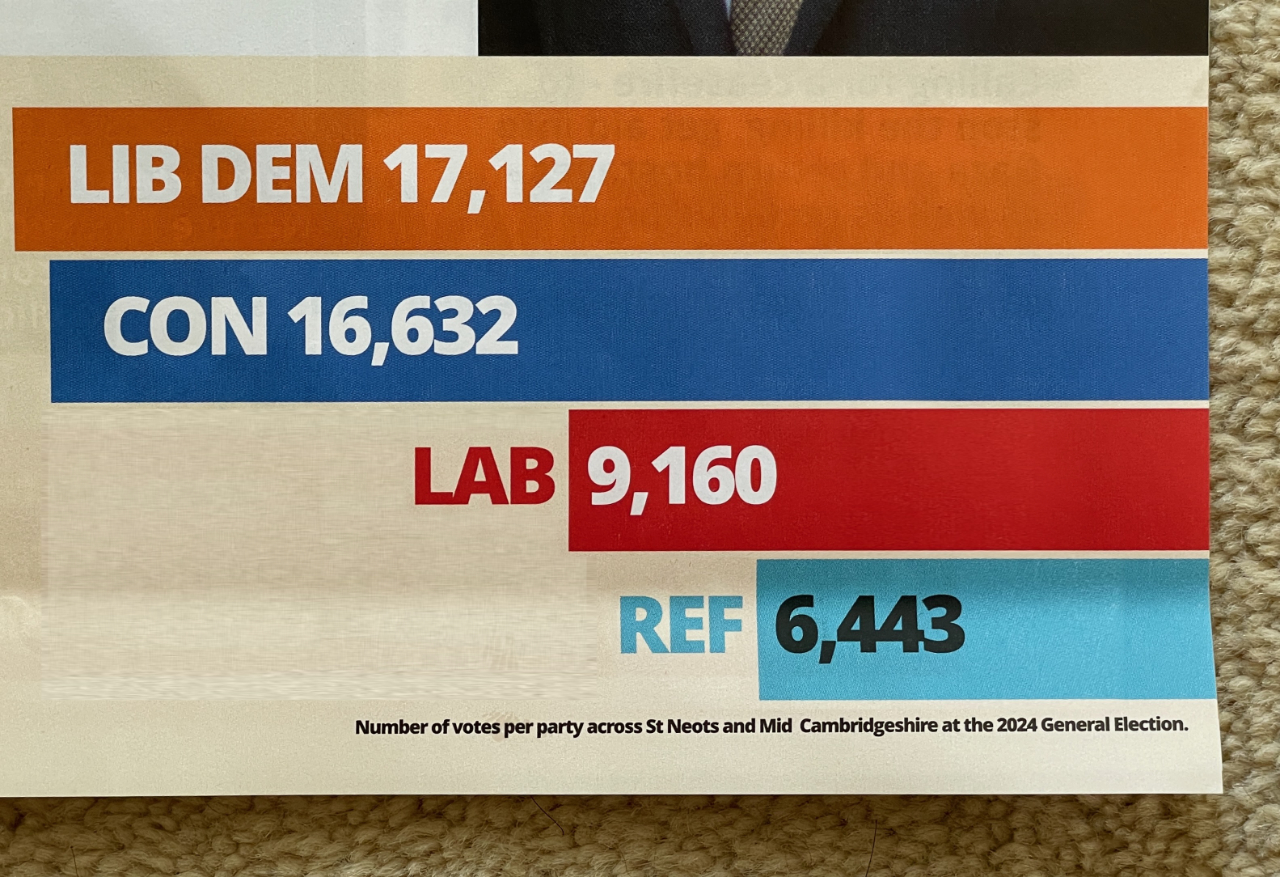
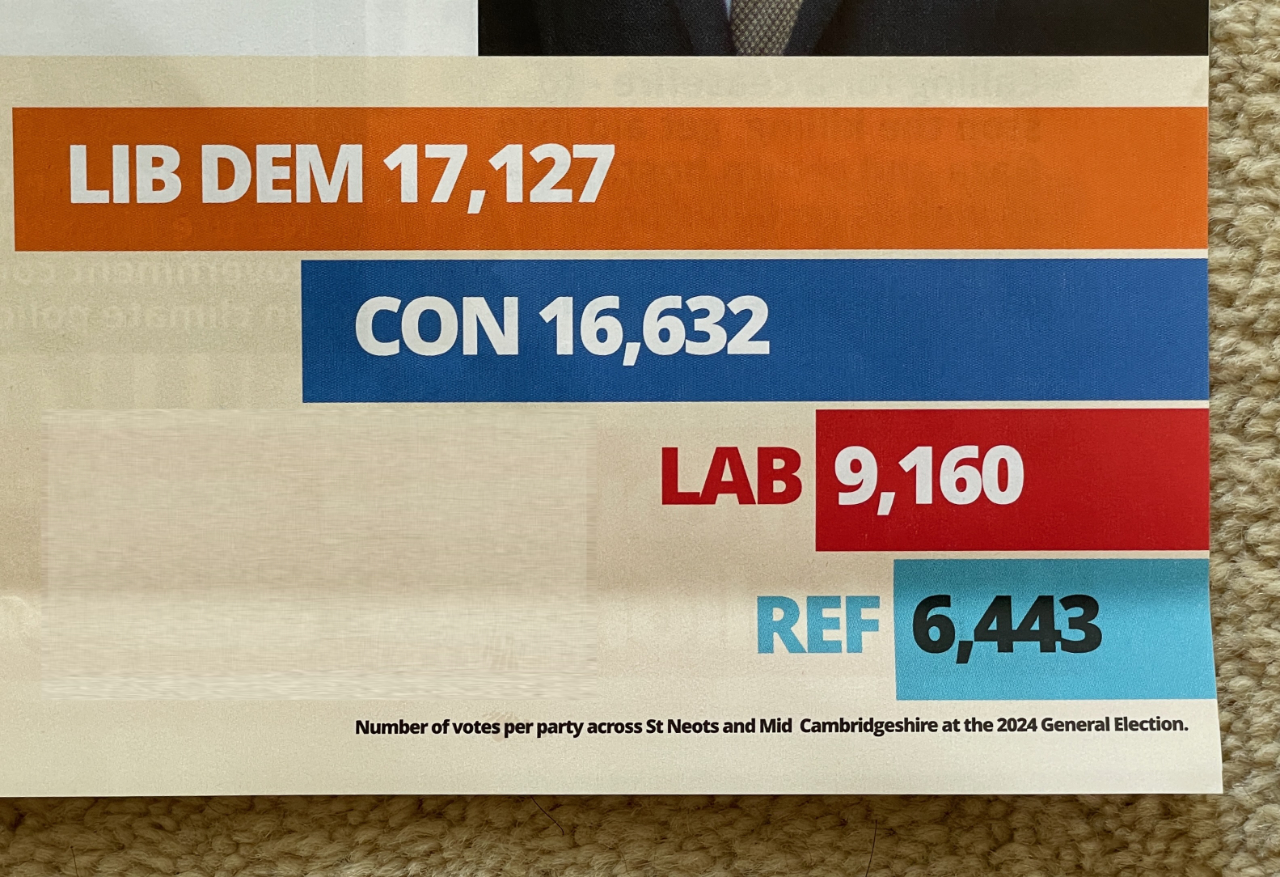
Let's take a look at that bar chart in the bottom right corner:

Basically, it (and the tone of this and other newsletters) is clear: our only close competition in this area was the Conservatives, and Ian gave them a damn good thrashing! Hurrah!

But look more closely at the actual numbers, and you'll see that the Conservative vote was actually over 97% of the Lib Dem vote! Is that what this chart says to you? And Labour got more than 50% of the Lib Dem number. Don't get me wrong, I'm still glad they won, but this chart is deliberately misleading - somebody created this, and made a choice to falsify the dimensions.

With the help of a bit of photoshopping, I can show you what the chart should look like to represent the facts accurately:

That looks less like a 'damn good thrashing' and more like 'by the skin of our teeth'!

It wouldn't surprise me to hear that Mr Sollom isn't the only one guilty of similar mathematical fraud. I wonder if the Advertising Standards Authority take any interest in political campaigns...

Reflections on Inflections

"I expect our sales", says the marketing manager confidently, "to have an inflection point in Q1 next year".

This is a pet peeve of mine. I've often heard sales and marketing types, and even economists and scientists who should know better, use 'inflection point' simply to mean 'a sudden change in the direction I'd prefer'. Perhaps they think an inflection point is the sharp bend in a hockey-stick-type curve, or the lowest point on a line that is about to turn upwards.

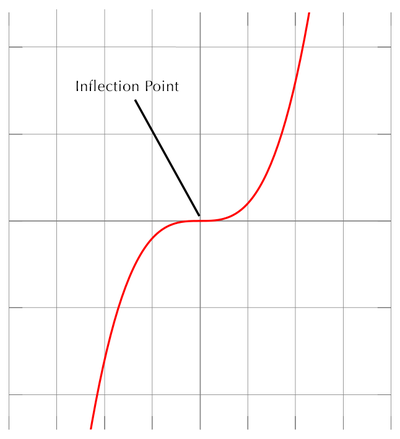
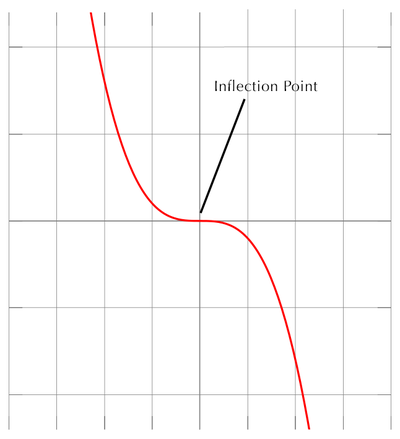
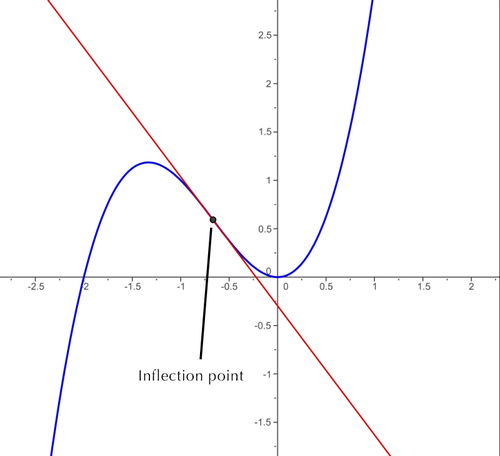
In fact, an inflection (or occasionally 'inflexion') point on a graph is technically where the second derivative is zero and changes sign: i.e. where the gradient changes from decreasing (or increasing) to increasing (or decreasing). Another way to think of it is that, viewed from the side, the line changes from concave to convex, or vice versa.

So, typically, an inflection point looks like this:

But, when touting your sales figures, remember that this is also an inflection point:

And so is this:

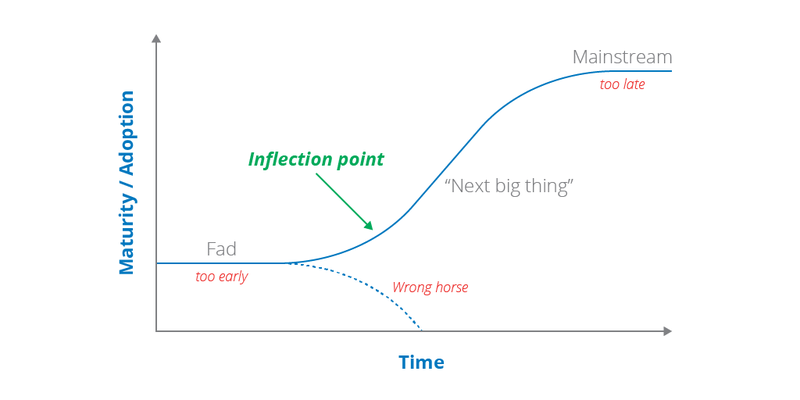
Doing a quick search, I came across an article from Thoughtworks all about inflection points and how they are important to your business. Sadly, they get it completely wrong.

As a technology leader, a portion of your analysis should revolve around determining inflection points, the critical phases of transitions along a technology's journey from an abstract idea to maturity. Inflection points are the points at which a product becomes a trend (something that will be used by a critical mass and therefore likely to drive value) instead of a fad (something that will fizzle out).

And here's their illustration:

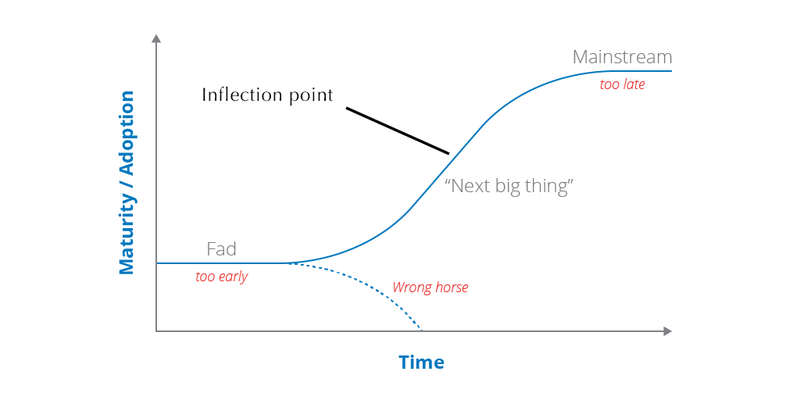
But you, gentle reader, know better. That's not an inflection point! This is an inflection point:

And if your strategy was to catch technologies there, I think you'd write a rather different article.

And then three come along at once...

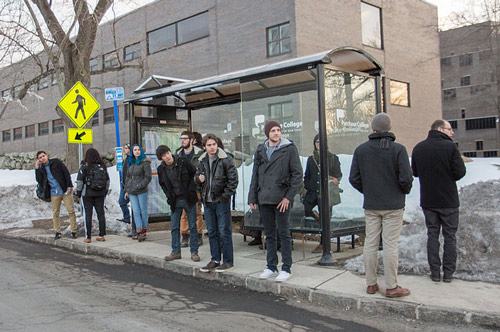
If you go to a bus stop where the bus arrives, on average, every 10 minutes, how long will you wait?

5 minutes, on average, right?

Wrong.

This is an example of The Inspection Paradox, a phenomenon of which I was dimly aware, but I came across some nice examples in my reading this morning - and it's an important thing to understand.

You see, 5 minutes would be the right answer if the bus came at exactly evenly-spaced 10 minute intervals. But this doesn't happen, at least, not outside Switzerland. So the gaps may be bigger or smaller.

If you arrive at a random time, you are more likely to hit one of the bigger gaps. The average waiting time that you, as a passenger, will experience, will therefore be higher. (Python programmers interested in a detailed analysis of this example could take a look at this blog post. If the arrival time follows a reasonably long-tailed Poisson distribution — admittedly unlikely in this particular example — then your average wait could actually be as high as 10 minutes.)

Allen Downey's blog has a range of other nice examples in here. You can read the whole thing if you want the details, but here are a few excerpts of the key points:

A common example is the apparent paradox of class sizes. Suppose you ask college students how big their classes are and average the responses. The result might be 56. But if you ask the school for the average class size, they might say 31. It sounds like someone is lying, but they could both be right.

Basically, if you sample students at random, you are often more likely to hit students in larger classes, and that will skew your statistics if you are trying to determine the actual average class size.

That's not necessarily a mistake. If you want to quantify student experience, the average across students might be a more meaningful statistic than the average across classes. But you have to be clear about what you are measuring and how you report it.

Here's another travel-related example:

The same effect applies to passenger planes. Airlines complain that they are losing money because so many flights are nearly empty. At the same time passengers complain that flying is miserable because planes are too full. They could both be right. When a flight is nearly empty, only a few passengers enjoy the extra space. But when a flight is full, many passengers feel the crunch.

The Inspection Paradox is relevant to social networks, too - real or virtual.

In 1991, Scott Feld presented the ""friendship paradox"": the observation that most people have fewer friends than their friends have.

If you think that everyone you know has a wider social circle than you do, it's because you are simply more likely to be in the social circles of people with bigger social circles.

That may or may not make you feel better, but at least you now have a name for it!

Photo: Frank Hank

Update, a few days later:

As I sit in a long phone queue waiting to talk to BT, my broadband provider, I ponder just how often, on such calls, I hear the phrase, "We are experiencing a large number of calls at the moment, and we apologise for the delay..." I have often thought, that, since they always seem to be experiencing an unusually large number of calls, perhaps they need to employ some more people.

But then I realise, of course, that I am one of those large numbers. It is natural that people will experience this more often than not, because more people will be calling during the periods when more people are calling...