Category: Computing

Misplaced trust

This might be a little technical for some readers, but don't worry, it's not actually the technical detail that's important...

On my home server, I run about half a dozen services that I need to access via a web browser, so they're all behind a Caddy reverse proxy which connects me to the right one, depending on the name I use in my browser: 'homeassistant', 'unifi', 'searxng', 'octoprint' etc. (All of these names are aliases for the same machine.)

One of these services is Nextcloud, which has user accounts, and I was thinking it would be handy if I could use those accounts to authorise access to the other services. Can I allow someone to use my web search frontend only if they have an account on my Nextcloud server, for example?

I thought I'd try out an AI system to see if it could speed up this process, because they're often good at this kind of thing - Google Gemini, in this case. And, to my delight, it gave me pages of detailed instructions.

It knew that Nextcloud supports the OpenID Connect system, told me how to set it up, and then how to use the oidc directive in the Caddy configuration file to connect the two, so that Caddy could ask Nextcloud whether the user should be allowed in. It gave me nice examples of oidc actually in use, and the parameters you'd need to configure when using it to talk to the Nextcloud instance.

"Great!", I thought, and grabbed a coffee, went upstairs to my machine, and started typing code to try it out. And it was then that I discovered...

Caddy doesn't actually have an oidc directive.

Five years before the iPhone

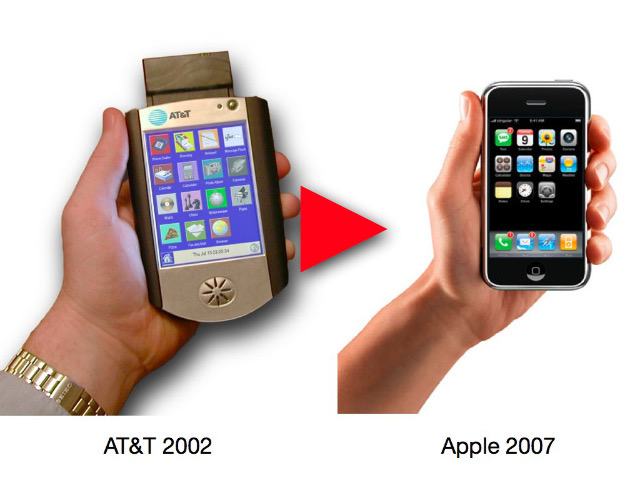
Trying to organise some of my old video footage recently, I came across a little demo I recorded of the AT&T Broadband Phone, a project we started in 1999 but which, sadly, died, along with the research lab that had created it, in 2002.

Looking back at it now, I notice how slow-paced it is compared to the typical YouTube video of today! So if you watch it, you might need a little patience! Nonetheless, it's quite fun to see some of the ideas we were considering back then, five or six years before the launch of the iPhone... things like the suggestion that streamed music "might be a service offered by a record company, where you pay a small amount for each track", for example...

Cordless Broadband phone and iPhone comparison

Direct link.

(P.S. I had an idea I had written about this here before... and indeed discovered that I had... but not since 2008, about eighteen months after the iPhone was launched.)

Coffee Pot - The Movie

For a long time, it has both bugged and bemused me that, though the first webcam ran for 10 years taking photos of our departmental coffee pot, there are almost no original images saved from the millions it served up to viewers around the world! I had one or two.

Then, suddenly, in a recent conversation, it occurred to me to check the Internet Archive's 'Wayback Machine', and, sure enough, in the second half of the coffeepot camera's life -- from 1996-2001 -- they had captured 28 of its images. I wrote a script to index and download these, and turned them into a slideshow, which you can find in my new and very exciting three-minute video:

Total Recall

The tech news has had a lot of coverage recently of Microsoft's proposed 'Recall' system, which (as a very rough approximation) takes a screenshot of your display every five seconds, and uses their AI-type Copilot system to allow you to search it. "What was that cafe or restaurant that someone in the call recommended yesterday?"

At first glance, this is a very appealing feature. Back in the 90s, when I was working on human-computer interaction stuff, we used to say things like "the more a secretary knows about you, the more helpful he or she can be". We were living in a world where your computer knew almost nothing about you except what you typed on your keyboard or clicked with your mouse.

Nowadays, however, users are more often concerned about your computer -- or someone with access to your computer -- knowing too much about you. The data used by Recall is only stored locally, but in a corporate environment, for example, somebody with admin access to your PC could scroll back to the last time you logged in to your online banking and see screenshots of your bank statements. So, potentially, could a piece of malware running with your access permissions (though that could also probably take snapshots of its own). You can tell the system not to record when you're using certain apps, or visiting certain websites... as long as you're using Microsoft's browser, of course. Or you can opt-out completely... but all of these require you to take action to preserve your privacy - the defaults are for everything to be switched on.

This caused enough of a storm that Microsoft recently switched it from being part of their next general release to being available only through the 'Windows Insider Program', pending further discussion.

There's been enough online debate that I won't revisit the arguments here about whether such a system could be built securely, whether we'd trust it more if it came from someone other than Microsoft, what the appropriate level of paranoia actually is, and so on.

There are, however, a couple of things I'd like to point out.

The first is that this facility was to be available, in the immediate future at least, only on PCs that meet Microsoft's 'CoPilot+' standard, meaning they had a neural processing unit (NPU) which allowed them to run the necessary neural network models at a sensible speed. And the only machines on the market that currently have that are ARM-based, not powered by AMD and Intel. I find it intriguing that the classic Intel x86 platform which has been so closely tied to Microsoft software for so long is not able to support such a headline feature of Windows. "We are partnering with Intel and AMD to bring Copilot+ PC experiences to PCs with their processors in the future."

The second is that, ahem, I predicted such a system, right here on this blog, 21 years ago.

Actually, though, my idea wasn't just based on screenshots. I wanted a jog-wheel that would allow you to rewind or fast-forward through the entire state of your machine's history: filesystem, configuration and all. One key component for this we didn't really have then, but it is much more readily available now: filesystems which can save an instantaneous snapshot without using much time or space to do it. As I wrote at the time,

The technology would need a quick way of doing ""freeze! – duplicate entire storage! – continue!"".

And that, at least, is now possible with filesystems like ZFS (which I use on my Linux home server), BTRFS (used by my Synology), and APFS (used on my Macs, where such snapshots are a key part of the Time Machine backup system). So one of the key requirements for my wishlist is now on almost all my machines.

And my Linux server is running NixOS, which means that I can, should I so desire, at boot time, select any of the past configurations from the last few months and boot into that -- Operating System, applications, configuration and all -- instead of the current version.

I haven't quite got my rewind/fast-forward jog-wheel yet, though. Oh, we do have that AI stuff... all very clever, I'm sure, but I'd rather have my jog-wheel. Let's give it another 21 years...
Some suggested reading: AI and dopamine

Andrew Curry's thoughtful newletter 'Just Two Things' arrives in my inbox three times a week (which, I confess, is slightly too often for me always to give it the attention it deserves). The two things he talks about today included some gems, though.

First, he looks at Ted Gioia's article, The State of the Culture, 2024 , which comes with the subtitle 'Or a glimpse into post-entertainment society (it's not pretty)'.

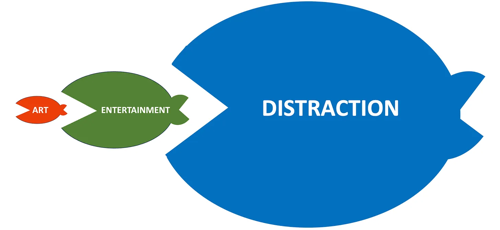
Gioia talks about the old dichotomy between Art and Entertainment:

Many creative people think these are the only options—both for them and their audience. Either they give the audience what it wants (the entertainer's job) or else they put demands on the public (that's where art begins).

but he then describes how a dopamine-driven world is changing that into something more complex and rather more worrying. This is only the beginning:

It's a good and interesting piece, and well worth reading, but if you find it depressing you should also read Curry's comments, which suggest things may not be as bad as they seem.

In the second of his Two Things, Curry talks about an article by Paul Taylor in the London Review of Books. (So, yes, you're reading my comments on Andrew Curry's comments on Paul Taylor's comments on other people's books. This is starting to resemble that fish picture above!)

The Taylor article is also very good, and I won't repeat too much of it here. I will, however, quote a section that Curry also quotes:

We should be genuinely awestruck by what ChatGPT and its competitors are capable of without succumbing to the illusion that this performance means their capacities are similar to ours. Confronted with computers that can produce fluent essays, instead of being astonished at how powerful they are, it's possible that we should be surprised that the generation of language that is meaningful to us turns out to be something that can be accomplished without real comprehension.

I like this, because it echoes Quentin's First Theorem of Artificial Intelligence, which I proposed here about a year ago.

What really worries people about recent developments in AI is not that the machines may become smarter than us.

It's that we may discover we're not really much smarter than the machines.

Again, the LRB article is well worth your time, if you can get through it before being distracted by things which offer you more dopamine.

Checking out the competition

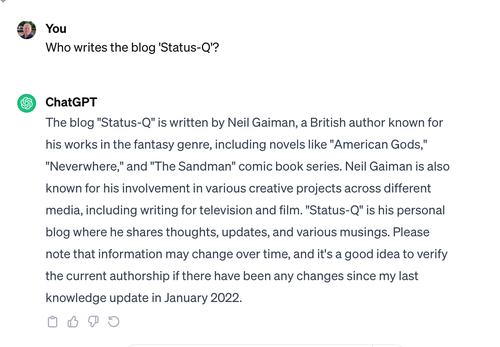
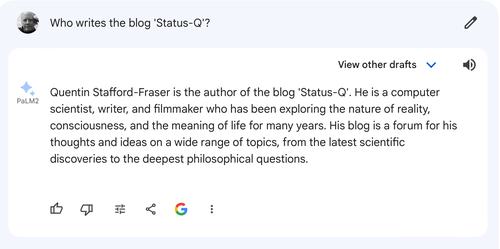
Google has just announced the launch of the Bard chatbot, its competitor to ChatGPT, and I, no doubt like many others, immediately went to compare their performance when asked some of the key questions of our age:

ChatGPT 3.5

The blog "Status-Q" is written by Neil Gaiman, a British author known for his works in the fantasy genre, including novels like "American Gods," "Neverwhere," and "The Sandman" comic book series. Neil Gaiman is also known for his involvement in various creative projects across different media, including writing for television and film. "Status-Q" is his personal blog where he shares thoughts, updates, and various musings. Please note that information may change over time, and it's a good idea to verify the current authorship if there have been any changes since my last knowledge update in January 2022.

Mmm.

OK, well, let's try...

Bard

Quentin Stafford-Fraser is the author of the blog 'Status-Q'. He is a computer scientist, writer, and filmmaker who has been exploring the nature of reality, consciousness, and the meaning of life for many years. His blog is a forum for his thoughts and ideas on a wide range of topics, from the latest scientific discoveries to the deepest philosophical questions.

Bard gets my vote.

Now, having done that important test, I can return to my career as a filmmaker who has been exploring the nature of reality, consciousness, and the meaning of life.

Sunny suggestion for a student project

I think this would be a fun student project. I would certainly have enjoyed it.


Here's a year's worth of my solar-generation data. My roof is oriented approximately 5 degrees west of south.

  1. How close can you get to discovering where I live, from this data alone?
  2. How can you improve your estimate by incorporating other publicly-available data sources?
  3. What further information about the installation would help you improve your estimate?

Feel free to make suggestions in the comments about fun additions.

The AI Ballad Of John Henry

Friends this side of the Atlantic may not be familar with the story of John Henry, but you can read about him on Wikipedia.  John Henry, the story goes, was a 'steel-driving man' whose prowess with the hammer was formidable.  

At one point, he took on a steam hammer, side-by-side, and won... but the effort also killed him.

It's not quite clear whether John Henry was ever anything more than a legend, but he has inspired statues, books, animations, compositions by Aaron Copland... and almost everybody seems to have recorded musical versions of the story, including Jerry Lee Lewis, Bruce Springsteen, Lonnie Denegan, Harry Belafonte, Woodie Guthrie... to name but a few.  For a brief version, here's Tennessee Ernie Ford, or I rather like the slightly longer story as recorded by Johnny Cash.

My friend Keshav, of course, asked ChatGPT to write a version, which also covers the threat posed to traditional skills by the coming of machines.


Who's a pretty Polly?

As is generally well known now, ChatGPT and similar LLM systems are basically just parrots. If they hear people saying 'Pieces of eight' often enough, they know it's a valid phrase, without knowing anything about the Spanish dollar. They may also know that 'eight' is often used in the same context as 'seven' and 'nine', and so guess that 'Pieces of nine' would be a valid phrase too... but they've never actually heard people say it, so are less likely to use it. A bit like a parrot. Or a human.

And when I say they know nothing about the phrase actually referring to Spanish currencies... that's only true until they read the Wikipedia page about it, and then, if asked, they'll be able to repeat phrases explaining the connection with silver coins. And if they read Treasure Island, they'll also associate the phrase with pirates, without ever having seen a silver Spanish coin. Or a pirate.

A bit like most humans.

The AI parrots can probably also tell you, though they've never been there or seen the mountain, that the coins were predominantly made with silver from Potosi, in Bolivia.

A bit like... well... rather fewer humans. (Who have also never been there or seen the mountain, but unfortunately are also not as well-read and are considerably more forgetful.)

Since so much human learning and output comes from reading, watching and listening to things and then repeating the bits we remember in different contexts, we are all shaken up when we realise that we've built machines that are better than us at reading, watching and listening to things and repeating the bits they remember in different contexts.

And this leads to Quentin's first theorem of Artificial Intelligence:

What really worries people about recent developments in AI is not that the machines may become smarter than us.

It's that we may discover we're not really much smarter than the machines.